Courts of Arcadia
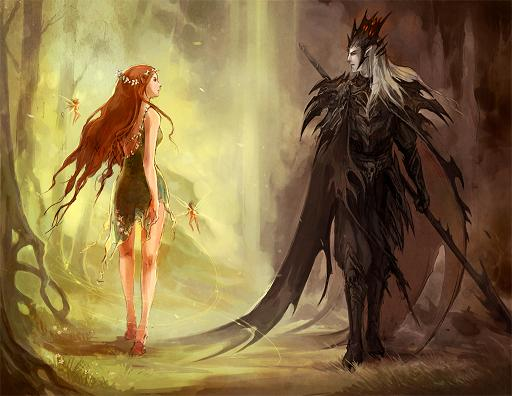
There are four Courts in Arcadia, each associated with one of the seasons (Spring, Summer, Autumn, and Winter). Besides owing fealty to their local Lord or Lady, nearly all Fey have an allegiance to one of these courts; those that do not are called wildlings, and generally treated as outcasts and sent to live in the Wyldlands. A Fey's allegiance is usually determined by which moon they are born under; sometimes, however, there are exceptions. For example, an entire noble house may choose to pledge their allegiance to a particular court, regardless of the timing of their birth.
The court to which a Fey belongs tends to influence their personality, their talents, and their role in Fey society, though an individual Fey may or may not conform precisely to the stereotype of their court. The primary reason behind these seasonal court divisions seems to have been philosophical differences. This has led to a handful of battles in the past, in what one could call a Fey civil war-- but once the Courts of Arcadia were established, territories were claimed and most of the noble families swore allegiance to one or the other; while conflicts still arise from time to time, an uneasy peace has been the standard ever since. More often than not, if a particular Court's armies are dispatched, it is to protect their borders from wildlings or to send aid to an allied realm, not to launch an offensive.
The Courts of Arcadia all have central locations where they hold their local festivities, each equally beautiful and steeped in magic but uniquely reflecting the nature of the season. All Fey are welcome to join in each of the court's festivities, but the nobility and Archfey of the appropriate season are required to attend. During each season, the ruler of that Court becomes Sovereign and is the one who hands down judgements, settles disputes, gives gifts, and leads Fey armies. The nobility and Archfey generally defer to whichever court is in season, unless the matter at hand is directly in the domain of a particular court. For example, when the Summer Court is in season (or "ascendant"), the Sovereign of Summer would be the one to settle a dispute between siblings over the right to rule a domain. However, no matter the ascendant season, the Sovereign would probably permit an Autumn Lord to judge a case involving a warband going rogue, as matters of combat tend to be the expertise of the Autumn Court.
These seasonal courts are, in theory, perfectly in balance, with no one more powerful than the others. In practice, however, powers within Arcadia have risen and fallen over the centuries. It is not uncommon for seasons to be ascendant for years at a time, nor would it be unnatural for a season to only be ascendant for a matter of weeks. Since a Sovereign, or leader of the reigning Court, can never be certain how long their influence will last, they are often very quick to make the most of their position.
At present, this cycle of shifting seasons has been... stagnant. And while it is perfectly acceptable for a season to be ascendant for however long the Fates have determined, the Winter Court has currently been ascendant for far longer than anyone thought possible.
Traditions Among the Courts
While each of the Courts of Arcadia have their own rules, forms of nobility, standards and beliefs, there are several ancient traditions that all courts follow and adhere to. These traditions have allowed all the various courts of Fey to interact civilly, and are considered universal and unbreakable (except by wyldlings). These include:
One's Word is One's Bond
Once word is given, one is honor-bound to fulfill it, and all others are held to the same standard. An oath-breaker may be punished by death. Careful wording of oaths, however, can create allowances (also known as "loop-holes"), so one should take great care when asking Fey for promises, or when giving their word to a Fey.
Giving Gifts
Unsolicited gifts are held with suspicion. A gift suggests an unspoken obligation to the giver, and is an especially grave insult if the giver is unknown. The price of a gift must be made clear upon giving, lest one anger the Fey, even though an ignorant non-Fey might simply be trying to show kindness. If a Fey gives a gift, there is always a reason; the Fey is expected to make these obligations clear in some fashion or another.
Emotional Expressions as Gifts
The only exception to gift-giving is in the expression of genuine emotion. Emotion, especially passion, are viewed as especially generous gifts, as they are given without expectation or necessity of reciprocity. Fey frequently show attachment towards those who have elicited great emotion, and therefore granted the gift of emotion. It is warned, however, that it is sometimes dangerous to attract these sorts of attentions-- especially among some of the darker Fey.
Acknowledge Beauty
It is considered rude to not acknowledge the beauty of the Fey. Seemingly flirting at all times, it really is a simple reality of politeness and etiquette among the Fey. Overt sensuality amongst the Fey is, therefore, quite common.
Preservation of Peace
In times of peace, it is forbidden for any Fey to deliberately slay another. Those who break this law are shunned and driven into exile in the Wyldlands.
Protect Lifebearers
Many Fey place a high value on keeping their bloodlines "pure", which tends to result in most Fey looking down on half-breeds with other ancestries. However, historically low levels of fertility among Fey means that they will never harm either children or the pregnant, no matter how undesirable or unwelcome the match may be.